
Before You Wanted to Be Impressive, You Just Loved the Thing
What the critic scene in Ratatouille reveals about lost wonder and how to find your way back to it.

There is a moment in 2007’s Ratatouille that lives rent-free in my mind.
The stone-faced food critic Anton, a man known for destroying restaurants with a single review, is given a dish to taste by the hopeful protagonists Remy and Linguine. Someone nearby scoffs at the dish. It’s ratatouille, nothing fancy. But when Anton takes a bite… suddenly, he is no longer a critic.
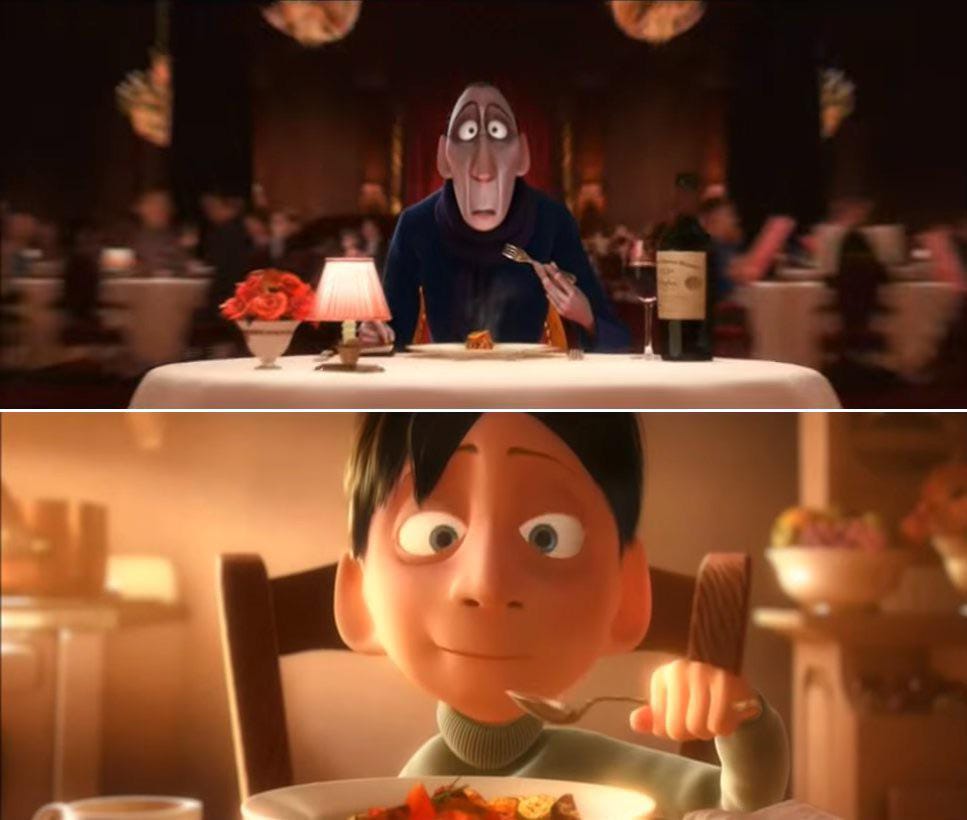
The taste pulls him into memory, into a kitchen, into a feeling that existed long before judgment. Long before standards. Long before Anton learned how to be a critic.
He is a child again, being comforted by his mother. She feeds him a plate of ratatouille, and he finds peace.
In my opinion, this is one of the greatest moments in all of cinema. The filmmakers do not send us into Anton’s past with a simple cutaway. Instead, the frame pulls him backward into the memory itself before returning him to the present seconds later. It captures the way memory actually feels: sudden, sensory, and powerful enough to collapse time.
This scene has stayed with me for nearly 20 years, because it reveals something many of us lose without noticing. Anton is a food critic, a man whose entire identity is built around judging what appears on the plate. But there was once a time when he simply loved food. Before opinions, standards, and reputation entered the picture, there was just the experience of it. The warmth, the comfort, the feeling of being cared for.
Ratatouille is a film about memory and cooking, but the moment points to something much broader. It reminds us that long before we learned how to evaluate the things we love, we simply loved them.
Most of us did not begin loving what we love because we were good at it. We loved it because it made us feel alive.
Writing before we cared if it was publishable.
Dancing before we knew how we looked.
Reading before we wondered what it said about us.
Over time, the audience grows louder. Metrics appear. Standards arrive. Our creativity doesn’t disappear because we forget how to make things; it fades because we forget how to be moved by them.
Instead, we perform, and we aim to impress instead of allowing ourselves to feel.
So, the real question becomes this:
How do we return to the moment before we were trying to impress anyone at all, and create from that place?
One thing I’ve noticed, both in my own life and in the work of people who have thought deeply about creativity, is that the way back is rarely intellectual.
Elizabeth Gilbert writes about following curiosity rather than chasing validation. Julia Cameron built an entire practice around refilling the creative well through morning pages and artist dates. Psychologists studying creative “flow” say our best work emerges when we lose our self-consciousness and become absorbed in the act itself.
Different language. Same truth.
Creativity returns when we stop performing and start participating again.
I am still learning how.
Throughout my twenties, I believed that if I wanted to be a writer, everything I created needed to be impressive. Every idea had to prove something. Every draft had to signal that I was talented enough to deserve the next opportunity. If the first attempt at something didn’t feel extraordinary, I would grow frustrated almost immediately, sometimes even defeated.
Without realizing it, I had begun performing the role of “frustrated writer” instead of simply writing.
Part of that mindset came from ambition. Part of it came from the culture we live in, where creativity is often tied to recognition, milestones, and visible success.
It becomes easy to believe that the point of making something is to demonstrate that you are worthy of attention.
But over time, that pressure drains the wonder out of the work.
When every attempt carries the weight of needing to be remarkable, very little feels safe enough to explore. Curiosity shrinks. Play disappears. The thing that once felt joyful starts to feel like a test you must pass.
What I’ve been relearning in my thirties is something much simpler and much harder at the same time: returning to the act itself.

To write because the opera in the Douro Valley scene I envision needs to exist. To read because “The Will of the Many” pulls me in so completely. To sit in a dark theater while Hamnet reminds me of the power of cinema. To wander through the National Gallery of Art because the Impressionists discovered 150 years ago how to make paint look like it’s moving, and I still can’t look away.
Moments like these don’t feel productive. They don’t immediately lead to output. But they reconnect me to the reason I loved storytelling in the first place.
That realization showed up for me in an unexpected way today.
It had been one of those days when the creative well felt dry. I write constantly for my day job, and by the time I turn to my own work, the pressure to get it right can feel heavy. There are always deadlines, expectations, and the quiet question that lingers behind every sentence: Is this good enough?
This afternoon, I got into an Uber to head home to Alexandria. Two days earlier, it had been eighty-five degrees. Today it was snowing, which felt absurd for March and somehow matched the strange mental whiplash of the day.
The driver, Jesse, had a radio station playing early 2000s music. Train’s “Drops of Jupiter” came on.
Suddenly, I was somewhere else entirely.
That song immediately brought me back to being a kid riding in the backseat of a car with my sister during a Massachusetts summer. Windows down. Sunlight through the glass. That feeling of being young enough that a song about loss and the universe could fill your entire world for three and a half minutes.
Now, without thinking about it, I started singing along.
After the first chorus, I said to Jesse, “This song is still great twenty-five years later.”
He agreed, and for the rest of the ride I just sang along in the backseat, completely forgetting about the emails, the deadlines, and the pressure that had filled the day. For a few minutes, there was no audience and nothing to prove. There was only the joy of a song that still felt alive.
And that, I think, is the feeling we are trying to return to.
The critic in Ratatouille does not rediscover his love of food through analysis. He rediscovers it through a single bite that reminds him of how food once felt.
Creativity often works the same way.
The way back is frequently sensory. A book you loved when you were young. A song you once played on repeat. A place, a smell, a ritual that carries you back to a version of yourself who loved the thing before it became something to prove.
These moments are not distractions from creative work. They are reminders of why the work mattered in the first place.
If we want to create from a place that feels energizing, we may have to return to those moments first. To the stories, songs, films, and experiences that moved us before we were trying to impress anyone.
Because that is where the love lives.
And it is often where the best art begins.
One of our most favorite movies! And great message.
Just the screen grab from that scene in Ratatouille and boom, instant tears. 1000% agree that it’s a top moment in cinema. Powerful.