
The Story I’m Still Writing
On what it means to live with an unfinished work and why letting it take its time might be the bravest thing you can do.

I came up with the idea for a story in 2009. Sixteen years later, I’m still writing it. And somewhere along the way, I realized that’s okay.
I was eighteen and co-directing a one-act play at my high school. While at Barnes & Noble searching for opening night cast gifts, I found the PostSecret books. It was based on a Tumblr-era project where people mailed their secrets to the site’s creator on scraps of paper and postcards, each one turned into an image and shared online. I opened up one of the books — I forget which version — and the confession stopped me cold.
Someone had mailed in this:
Everyone who knew me before 9/11 thinks I am dead.
I stood there, in this book behemoth in Framingham, MA, bombarded by a flurry of questions. Who was this person? What happened to them? What made them write this? That single sentence became the seed of what I have now spent nearly two decades trying to write, or rather, understand.
It stayed with me because it wasn’t just a confession. It was a rupture between two lives — the one that existed before and the one that had to begin again. I didn’t know it then, but something in that secret mirrored the quiet dissonance of my own generation.
We were old enough to remember a world that felt safe and young enough to lose it before we could name what had changed.
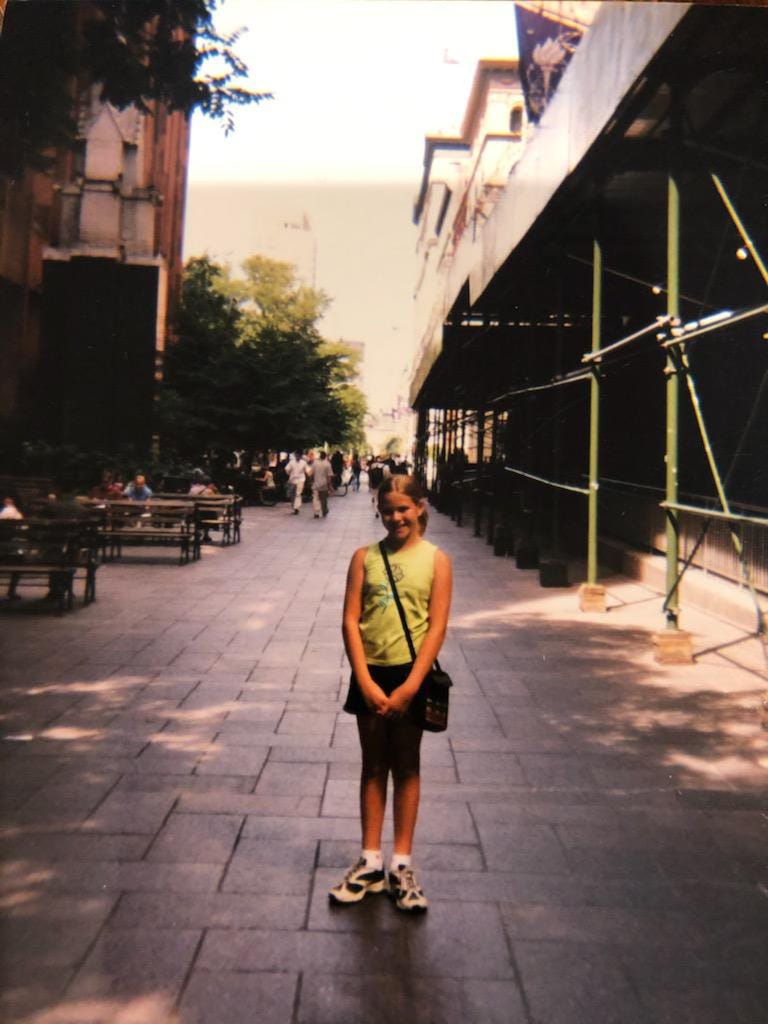
When I was eleven, I lived through 9/11 like everyone else my age, part of the so-called “peak millennials,” born in 1990 and 1991, who grew up in the glow of the 90s and lost it overnight. I was sitting in my fifth-grade classroom when the teachers told us what had happened. I raised my hand and asked to call home because my sister and her boyfriend worked in New York City. My teacher brushed it off and said, “Well, we all have sisters’ boyfriends.”
I didn’t lose anyone that day (thank God), but it marked something in me. I grew up both inside my life and somehow just above it, always watching, always wondering what it all meant. Maybe that’s why I have been trying to tell this story ever since.
Over the years, the story changed forms. In college, I tried writing it as a screenplay. After graduation, I tried again. When I moved to Los Angeles, still trying to become a filmmaker, I told people about it constantly. It was the story I couldn’t shake, the one I would write when I finally “figured it out.” I filled notebooks with false starts and outlines, convinced I just hadn’t cracked the code yet.
If you’ve ever carried a creative idea that won’t let you go, you know the feeling. The notes that multiply. The drafts that almost work. The quiet promise that one day you’ll finally get it right.
I thought the answer was more effort, more pushing, more doing. And sometimes that’s true. Discipline matters. But I’ve learned that art often asks for something gentler, a kind of listening that can’t be rushed.
There’s a difference between writing through resistance and forcing something before it’s ready. The first deepens you; the second drains you.
In 2018, I finally wrote a short story version that felt real. Eleven pages were somehow written in seven hours. For the first time, it was out of my head and onto paper. I felt relieved, almost proud. Then I tucked it away, certain that now, finally, I could write the “real” screenplay version.
I didn’t.
Looking back, I don’t think I was emotionally ready. Not because I hadn’t “lived enough,” but because I hadn’t yet developed the self-trust to tell something that vulnerable. My protagonist mirrored parts of me I was still afraid to face, and writing about redemption is difficult when you’re still learning to believe you deserve it.
A year later, I revisited the story and shared it with a few close friends. One said, “This is really good.” I was stunned. I had spent so many years doubting my voice that I couldn’t believe anyone meant their praise. But people connected with it. Some even said it healed something in them. That response reminded me that work doesn’t have to be finished to matter.
I had done a lot of creative healing (thanks to The Artist’s Way) by 2020. The story became a quarterfinalist in the ScreenCraft Short Story competition, a small but meaningful nod. Then came a pandemic, a cross-country move, and a quiet unravelling of what I thought my creative life was supposed to be.
I rented a converted carriage house in New Orleans for a month and wrote the first draft of the novel version in 2023. It was short, closer to a novella, but it existed. Then life shifted again—new job, new home, new beginnings back on the East Coast. I put the story down, and that was okay. I wrote other things, moved other projects forward, and focused on rebuilding. The creative process isn’t linear. It loops, pauses, and recalibrates. Every season has its purpose.
In 2024, I used the short story to apply to the DISQUIET International Literary Program in Lisbon. I got in.
My mentor, Katherine, told me something I have carried ever since: “Sometimes you have to let a story go. If it’s meant for you, it will come back.”
She was right. That year, I stopped forcing it. I revised the story one last time and set it aside.
Then, quietly, it returned.
In 2025, something shifted. I realized I wanted to explore the characters’ journeys across a trilogy instead of a single book. I outlined a version of the first novel that finally feels like the story I was always trying to tell. It isn’t a redemption story after all, but one about what happens when we avoid the things that haunt us. I know. Very meta.
I’ve started writing again, slowly, without urgency or guilt. I no longer measure progress in word counts or deadlines. I measure it in presence, the willingness to meet the work where it is, even when it asks for more time.
That kind of patience takes courage. The outside world rewards results.
We live in a culture obsessed with output, where worth is measured by what’s done, not what’s being shaped. But creative endurance is an act of quiet rebellion. To let something take its time is to trust that the process itself has meaning. To believe that the waiting, the reworking, the returning, are not detours; they’re the work.
Some stories take months. Others take decades. Both are okay.
If you’re carrying a long story too, one that has changed shapes, resisted your timelines, or simply asked for patience, maybe you’ll recognize this.
It isn’t a failure to still be writing.
It’s faith.
Faith that the story will return when you are ready for it. Faith that time is not the enemy of art, but its teacher.
I used to think I was chasing a finish line. Now I see that I have been living in the story all along, becoming the person capable of telling it.
Maybe that’s what the creative process really is, not a race toward completion, but a conversation between who you were when the idea found you and who you have become while learning to honor it.
Somewhere between those two selves, the story waits.
And when it’s ready, and when you are, you’ll meet each other again.