
What It Means to Live in Story
A reflection on slowing down, finding meaning in small moments, and living with the rhythm of a story rather than the rush of the world.

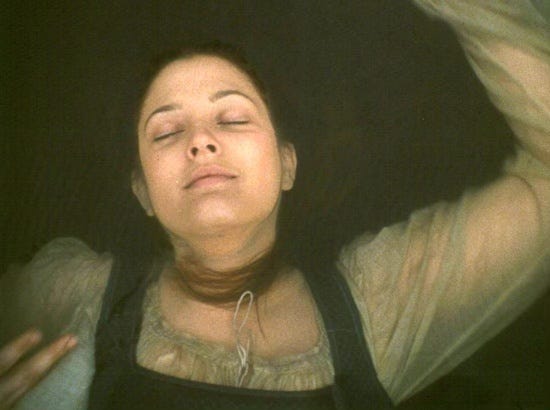
I was seven when I first saw Ever After, a retelling of Cinderella. Though it’s remembered for its romance, the moment that has lingered with me all these years isn’t about love at all. It’s something smaller, a fleeting glimpse of grace.
Danielle, our Cinderella, is weighed down by the demands of her stepmother. Despite her lot in life, she still finds space for peace. In my favorite non-romantic moment, she slips into the river after picking truffles, accompanied by George Fenton’s luminous score. The scene lasts no more than twenty seconds before she’s interrupted by Leonardo da Vinci “walking on water,” but in that brief pause, she is no one’s servant, no one’s burden. She is simply herself — free, peaceful, and bathed in light. That image has lived in me for decades. It felt like a promise that even within hardship, there can be moments that feel like freedom.
I think about that scene often. At seven, I couldn’t name what I felt watching it. But now, as a millennial woman who has known the pace of hustle and the pressure to produce, I recognize in Danielle’s pause something I’ve been searching for myself.
Stories have a way of doing that. They give us images that stay with us long after the credits fade or the last page is turned… mirrors for our unspoken desires.
When I began Live In Story, it was partly an experiment. I wanted a place for words, beauty, and reflection, but I didn’t yet know what shape it would take. I wrote a few essays, shared a few inspired thoughts, then drifted away. Without a clear sense of purpose, the newsletter became difficult to sustain alongside the demands of “real life” and my day job. What I had hoped would feel like an outlet began to feel like more work.
In time, I realized what I truly wanted was to write about living differently, to explore what living in story really means to me. It isn’t about producing more content; it’s about learning to live with more presence. Less rush, more quiet. Less output, more meaning and intention. And as I paid attention, I began to see that many women my age are searching for the same thing. Across articles, essays, and conversations with friends, there is a shared longing — a desire for a softer life, one not driven by hustle but by room to breathe, to create, or to simply be. Some call it slow living, others the soft life. Whatever the name, it feels like a gentle form of resistance to urgency.
For me, living in story means paying attention to small moments and seeing them as part of a larger narrative. A morning coffee can be an opening scene. A career change can be a turning point rather than a disruption. A long pause or a season of waiting might be its own chapter. Stories remind us that even the quiet passages matter, and that each moment or phase belongs to the larger tapestry of a creative life.
Stories, particularly in books and films, have always helped me see this more clearly. Ever After teaches me that even a brief, wordless moment can hold the essence of freedom. Carlos Ruiz Zafón’s The Shadow of the Wind reveals how stories wait to be discovered, hidden treasures in plain sight. Richard Curtis’s About Timereminds me that ordinary days, when seen with attention, are already extraordinary.
These works do more than entertain.
They remind us that life itself can be read as a story if we are willing to notice.
I want to be clear: I don’t write these words as someone with the answers. I don’t have a map, and I’m learning alongside you. My questions are likely yours. How do we slow down when the world keeps accelerating? How do we create when time feels scarce? How do we hold onto beauty when distraction is constant? I don’t know, not completely. But I believe the asking matters, and that story gives us a language for the asking.
So this is where I begin again. Live In Story is not a manual or a guidebook. It is a companion on the road, a place to pause, to reflect, and to notice. Here is my quiet invitation: if your life were a novel, what would this chapter be called? It doesn’t have to be grand or tidy. It only has to be yours. Perhaps this moment is foreshadowing. Perhaps it is a quiet interlude. Whatever it is, it belongs to your story.
That, to me, is what it means to live in story. It is not about controlling the narrative but about recognizing it. It is choosing to see that meaning is already here, waiting to be noticed. Like that quiet scene by the river, when she steps into the water and lets herself drift beneath the sun, we too can find moments of stillness that remind us who we are.